
cloud collecting #50: Jolanda Moletta
on the human voice as the most powerful and ancient instrument

I’m happy that the 50th cloud collecting interview is with Italian vocalist, composer and multimedia artist Jolanda Moletta. I’ve been a longtime admirer of Jolanda’s work, so it was exciting to ask her a few questions following the release of her recent album, Oceanine, via Beacon Sound in which she collaborates with 11 women artists. She also appears on the recently released cloud collecting x Echoes Blue curated compilation, gentle voices, vol. 1, teaming up on a song with New Zealand-based artist Birds of Passage. Jolanda is a powerful advocate for uplifting women’s voices, while using her own artistry to channel imagination, connection with nature, and hope into the world. I highly encourage diving into her catalog.
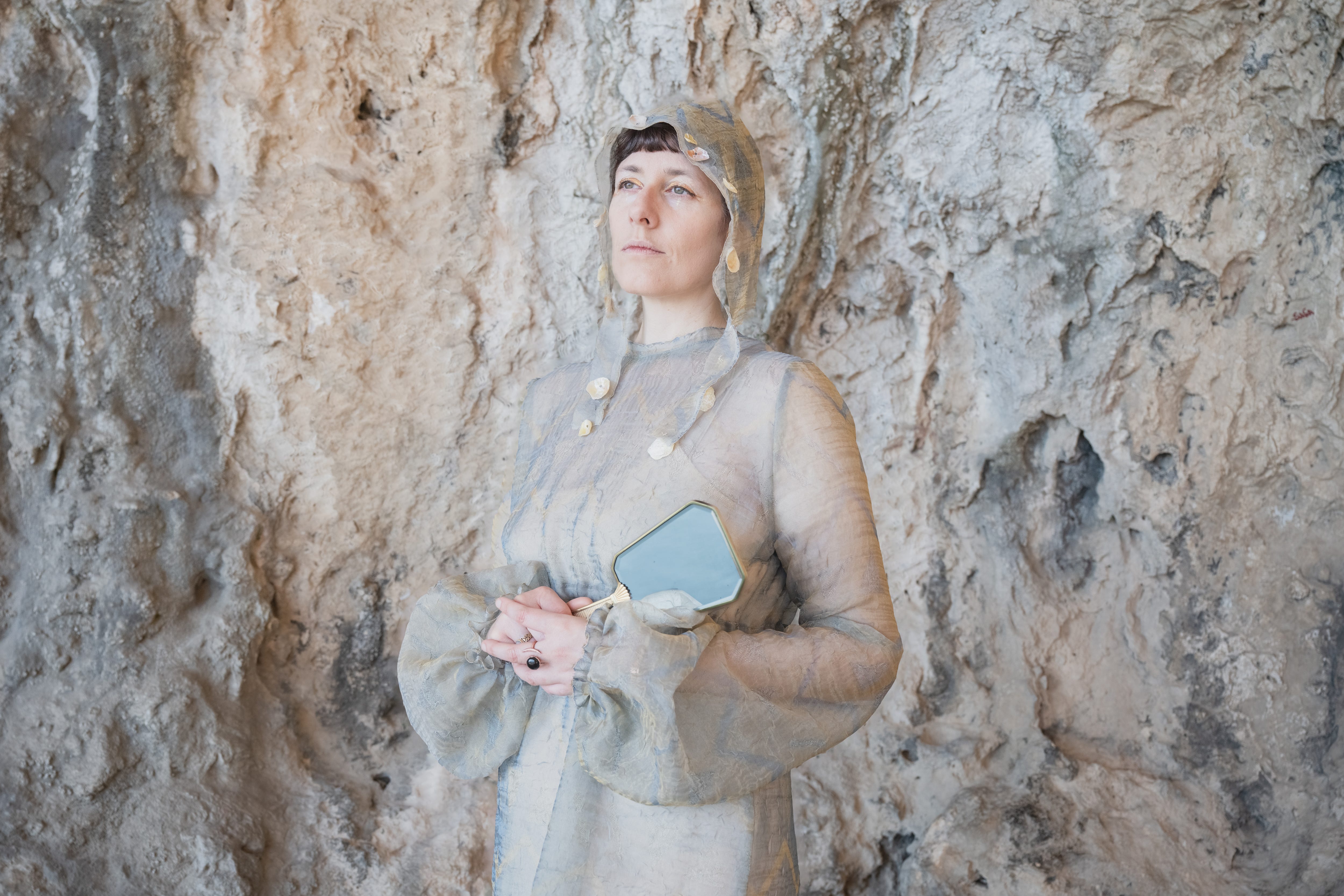
Jolanda Moletta is a multimedia artist and one-woman electronic choir. She creates wordless compositions through extended vocal techniques, integrating wearable-controlled live processing, alongside symbolic visuals. Moletta considers her performances to be a collective ritual and creates her Sonic & Visual Spells following the cycles of nature and the moon. Jolanda’s 2022 critically acclaimed album Nine Spells was released on the Ambientologist label, followed by Night Caves on Whitelabrecs in 2025. In 2022 Jolanda was invited to play her album Nine Spells live at Netherlands based festival Le Guess Who? The album was featured on Bandcamp Daily, many Spotify Playlists (including Best of Ambient 2022, Ethereal Vocals, EQUAL Ambient) and appeared in mixes for Crack Magazine, NTS and more.
In 2023, she debuted Sacred Space at The Museum of Natural History in Turin (IT), a ritual performance exploring the relationship between the sacred and the feminine.
In 2024, Moletta collaborated with Australian artist Karen Vogt on the long-form vocal piece Suspended Between Worlds (Longform Editions), followed in 2025 by their full-length album Sea-swallowed Wands (Quiet Details). Her latest record, Oceanine, was released by Beacon Sound in May 2026.
Beyond music, Moletta’s interdisciplinary practice spans film, collage, and visual performance.
Jolanda Moletta’s artistic practice is a radical and spiritual journey through sound art, ritual, and the symbolic archaeology of the feminine. A single voice, multiplied, to give form to the unseen.
1. Your voice is the foundational instrument across Oceanine and much of your music. What is the history of your voice as an instrument? And when did you first start thinking of your voice not just as a means of expression, but as a material you could shape and build with?
I’m entirely self-taught when it comes to singing. I’ve been exploring voice and sound for almost twenty years now. Spending years touring and recording albums with my band She Owl taught me so much about my voice: how it works, its possibilities, limits, and emotional potential. Over time, I became fascinated not only by melody or lyrics, but by the physicality of the human voice itself: breath, resonance, vibration, texture, and tone. Gradually, I stopped thinking of the voice simply as a vehicle for expression and began to experience it as a material I could sculpt and build with.
I became fully aware of this during the making of Nine Spells in 2022, my first work created solely through the layering and shaping of my own voice. Through recording, stacking and processing the voice, I understood that my body itself was a unique instrument. The process felt transformative and almost ritualistic. I realized my voice was no longer simply a means of expression; it had become the raw material through which I could build entire emotional and symbolic landscapes. Since then, my work has evolved into what I call Sonic and Visual Spells: immersive works that combine vocals, symbolism, film, and visual art to communicate with the subconscious mind.
In recent years, I became increasingly interested in stripping language away from the voice. Instead of relying on lyrics, I began focusing primarily on vowels, occasionally introducing consonants to create sounds that feel almost like words without ever fully becoming them. Each vowel carries a different sonic and emotional quality for me: “A” can feel open and stable, “E” luminous and hopeful, “U” grounding and earthy. Many spiritual and musical traditions use sung vowels in rituals and meditative practices, and across cultures there is often the idea that creation itself begins with a vocalized sound. I’m fascinated by the potency of the voice when words are removed, because it allows the sound to transcend language and communicate in a more instinctive, universal way.
What continues to inspire me most is the voice’s ability to create connection: between people, between inner and outer worlds, between the personal and the collective. My research into myths, archetypes, folklore, and ritual constantly returns me to this idea of voice as invocation, memory, and transformation. For me, the human voice remains the most powerful and ancient instrument we possess: something deeply human, yet capable of carrying us beyond ourselves.
2. Each track on Oceanine is a duet with another woman artist and the album feels like it holds a larger collective presence. I would love to hear more about how the concept of Oceanine originated and how you got this amazing group of women to come together.
Oceanine began from a very personal place: my lifelong connection to the Mediterranean Sea and to the myths, symbols, and archetypes that emerge from it, especially the figure of the siren. From the beginning, I knew I didn’t want the album to feel like a series of isolated collaborations, but rather like a shared ritual or collective body of voices. Even though each track centers around a different vocalist, I wanted the album to carry the feeling of a larger feminine presence flowing through it as a whole.
The concept really grew out of this idea of reclaiming the female voice, not just individually, but collectively. I was thinking a lot about how women’s voices and archetypes have historically been reduced, feared, or simplified, especially figures like the siren, who originally carried associations with prophecy, transformation, and hidden knowledge. I wanted Oceanine to create a space where many different emotional and sonic expressions of femininity could coexist: luminous, dark, tender, wild, fractured, soothing, powerful.
Every single vocalist I involved is an artist I deeply admire and whose work I genuinely love. Some of them I had already met in real life and seen perform live, and their music left a profound impression on me. Artists like Nadine Khouri, Laryssa Kim, Mt Fog, Nightbird and Singer Mali completely mesmerized me when I saw them perform. Others I didn’t know personally at first, but I had been following their work for a long time and speaking with them through social media, gradually falling in love with their music and artistic world, like Yellow Belly and Vargkvint.
Astrid Williamson is someone I’ve been a huge fan of for years. I actually met her backstage at a Dead Can Dance show in Berlin years ago, and we ended up talking about tarot and music and even discussed the idea of performing together. Unfortunately, it was right at the beginning of 2020, so those plans never materialized, but I still hope we’ll make something happen one day. Karen Vogt is also a longtime collaborator and dear friend: we’ve already released music together in the past, so inviting her into Oceanine felt completely natural. Elska and Camilla Battaglia are artists I met in person as well, and I already deeply admired the beauty and uniqueness of their work before this project.
So the album came together very organically through admiration, friendship, artistic connection, and mutual trust. I invited each vocalist to contribute a very short, raw melodic fragment inspired by the siren and water-nymph archetype, but I also encouraged them to move beyond something purely ethereal or “beautiful” and explore the full emotional spectrum: rage, loneliness, freedom, grief, desire, mystery. From those small vocal seeds, I composed entire pieces around them.
What helped create that larger collective feeling is that, although every song is unique, the entire surrounding sonic world is built entirely from my own layered and processed voice. In a way, my voice becomes the ocean itself: holding, carrying, and surrounding all of these different voices within the same body of water. By the end of the process, it no longer felt like eleven separate collaborations, but like a kind of choir made from many perspectives and energies, all connected beneath the surface.
3. How do you cloud collect (connect to childlike wonder) in your creativity?
I’d love to answer this question as if it were a list of ingredients for a spell, one that anyone could adapt into their own ritual.
A Spell for Cloud Collecting: daydreaming with open-hearted wonder, watching fireflies on a summer evening, seashell wind chimes singing in the breeze, stargazing until the sky feels endless, moonlight bathing, night swims in the sea, the purr of a cat, traveling to remote and ancient sacred places, writing by hand in a beautiful handmade notebook, purple crystals catching the light, planting seeds, both real ones and imaginary ones, and patiently watching them grow. Add fire, water, air, earth and a generous amount of courage to dream bigger than logic allows.
That’s how I reconnect with childlike wonder in my creativity: by staying close to awe, curiosity, ritual, and the small magical moments that make the world feel alive.
An utterly magical album by Jolanda. She's amazing!! I'm happy to be part of this album alongside many talented women artists. Congrats Cynthia on your 50th cloud collecting series! Raising a glass - three of cups style!!!